DLSS 5 lands in NBA 2K27, and it only runs on GeForce RTX 50 cards
NVIDIA's 11-minute DLSS 5 deep dive shows 3D-Guided Neural Rendering running in NBA 2K27, a feature locked to GeForce RTX 50 Series cards.
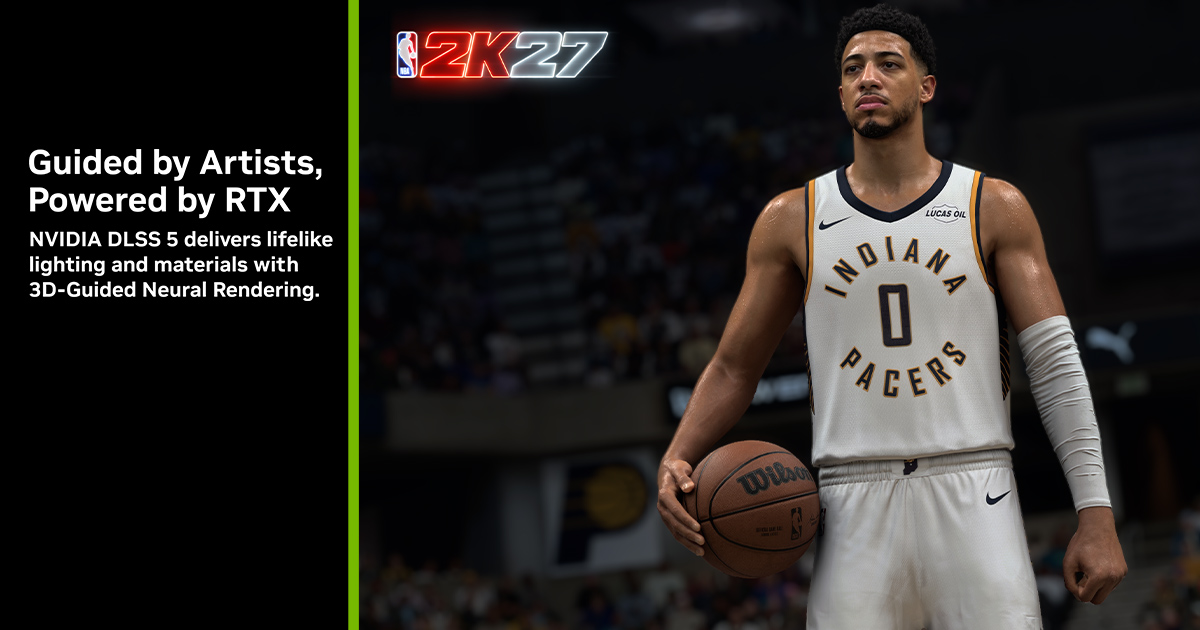
NVIDIA put an 11-minute technical walkthrough of DLSS 5 on its GeForce channel on 1 September, and it is still the most detailed public explanation of what the company calls 3D-Guided Neural Rendering. The same day, the feature went live in NBA 2K27 from Visual Concepts and 2K, the first shipping game to use it. It runs only on GeForce RTX 50 Series hardware, a tier above anything listed on the game's own system requirements.
What the deep-dive actually covers
The upload, titled "DLSS 5 | Introducing 3D-Guided Neural Rendering", runs exactly 11:00 and is presented by two NVIDIA staff the company names in its own caption: Edward Liu, director of applied deep learning research, and Gabriele Leone, director of content technology. It carries no chapter markers and no disclaimer separating cinematic footage from gameplay, so the NBA 2K27 sequences in it should be read as material NVIDIA selected and captured rather than as a benchmark run you could reproduce. The still comparisons published alongside the video are each stamped "DLSS 5 On" in the corner of the frame.
The technical argument is clean. Earlier DLSS features reconstructed data the engine had already produced: higher-resolution images from Super Resolution, interpolated frames from Frame Generation, cleaner ray-traced lighting from Ray Reconstruction. DLSS 5 sits at the end of the pipeline instead and adds lighting and material detail the engine never rendered at all, taking the finished frame plus motion vectors as its input. NVIDIA describes the model as one frame in, one frame out, deterministic, and trained against engine buffers for colour, surface albedo, detailed lighting and surface normals so that geometry and facial likeness cannot drift between frames.
What that buys, in NVIDIA's description, is subsurface scattering in skin, light transmitting through hair and foliage, tighter contact shadows and added ambient occlusion. The company is unusually explicit that the output scales with the input: the same model produces a far better result on a ray-traced or path-traced frame than on a purely rasterised one. Integration runs through the existing NVIDIA Streamline framework or an Unreal Engine 5 plugin, and it is independent of Super Resolution, Multi Frame Generation and Ray Reconstruction rather than a replacement for them.
The hardware gate
- DLSS 5 requires a GeForce RTX 50 Series desktop or laptop GPU. It is also available on GeForce NOW Ultimate, streamed from RTX 5080-class servers.
- Game Ready driver 616.64 WHQL was needed to expose the in-game toggle at launch. NVIDIA replaced it with 616.92 WHQL on 9 September.
- NBA 2K27 lists a GeForce RTX 2070 8 GB as its recommended GPU and a GTX 1060 5 GB as its minimum, plus 110 GB on an SSD and an AVX2-capable processor.
- The game is $69.99 on Steam and Windows-only there, with advanced access from 26 August for Deluxe and Ultra buyers and general launch on 4 September.
The gap between those two lines is the story. Nothing in the game's published requirements will run the feature the video is selling, and the store page does not mention DLSS 5 or an RTX 50 requirement anywhere in its specification box. Anyone reading the requirements to decide what to buy would have no way of knowing that the headline visual upgrade is gated to one generation of cards.
How to read the frame-rate numbers
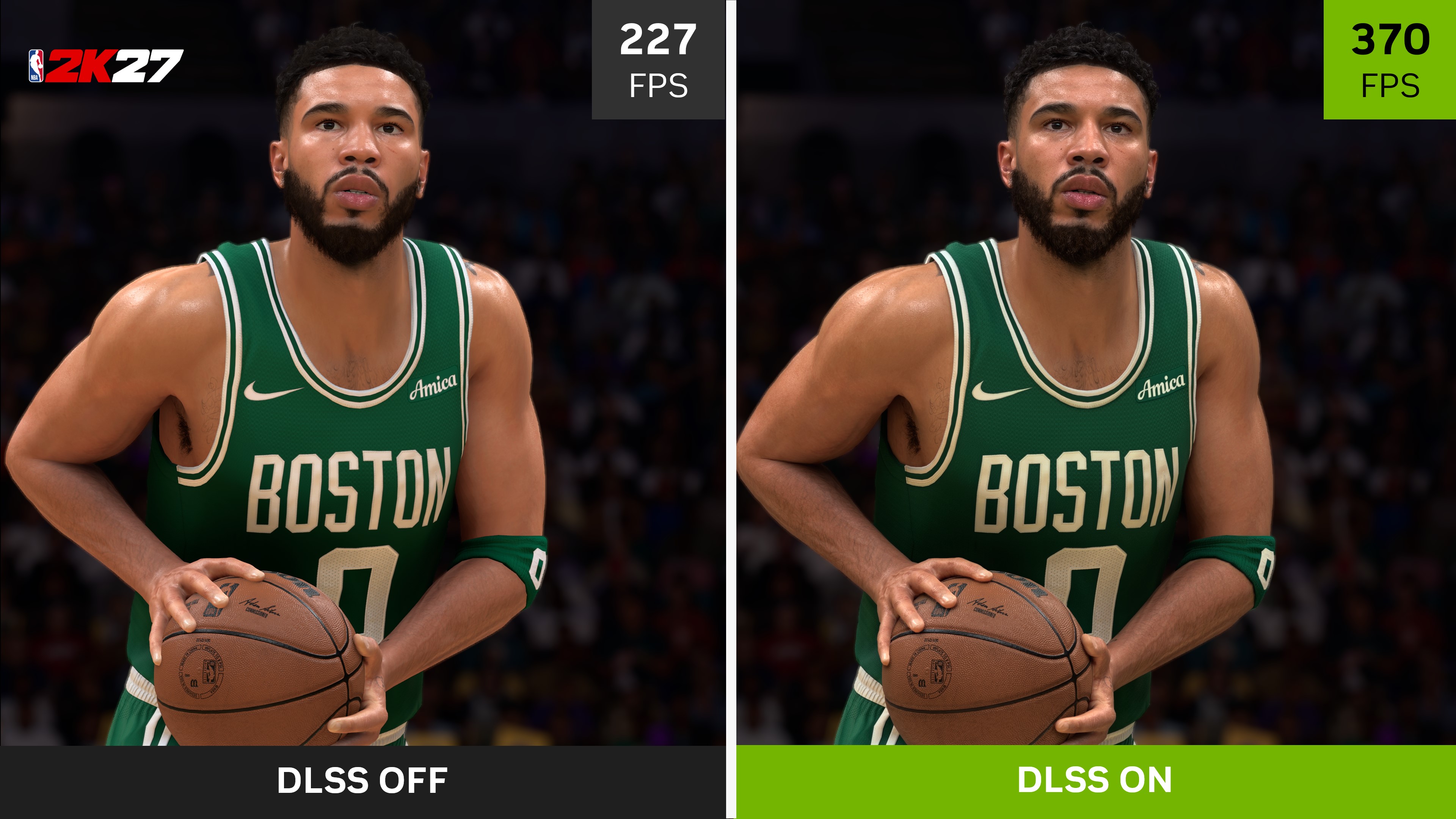
NVIDIA's own figures are specific: up to 370 fps at 4K with the Ultra preset and ray tracing on an RTX 5090, and at 2560x1440 with the same preset, up to 590 fps on the RTX 5090, 410 on the RTX 5080, 350 on the RTX 5070 Ti and 260 on the RTX 5070. At 1920x1080 the company says virtually the whole RTX 50 line can run Ultra with ray tracing and DLSS 5 enabled.
The footnotes on those charts matter more than the bars. Both were measured on a Ryzen 7 9800X3D with 64 GB of RAM under Windows 11 x64, and both were taken with Multi Frame Generation set to 6X. The 1440p chart used Super Resolution in Quality mode; the 4K chart used Performance mode, meaning the engine is rendering at roughly 1080p internally before upscaling. On NVIDIA's own accounting for the DLSS 4.5 suite, that combination leaves the engine drawing about one pixel in every 24. These are throughput numbers for a generated frame stream, not a measure of how often the game simulation updates.
The settings behind the screenshot
The video-settings capture NVIDIA published is the most useful single image in the whole package, because it shows what the toggle sits next to. At 3840x2160 the menu reads DLSS Super Resolution as the scaling method, Performance as the scaling quality, DLSS Frame Generation with a 2X multiplier, Reflex Low Latency on, and DLSS Neural Rendering switched to On. The VRAM readout in the same shot shows 5.95 GB of 10.23 GB in use.
“DLSS 3D-guided neural rendering helped boost the visual quality of our materials and lighting, bringing a real jump to photorealism across the game.”Peter Kavic, Senior Producer, Visual Concepts
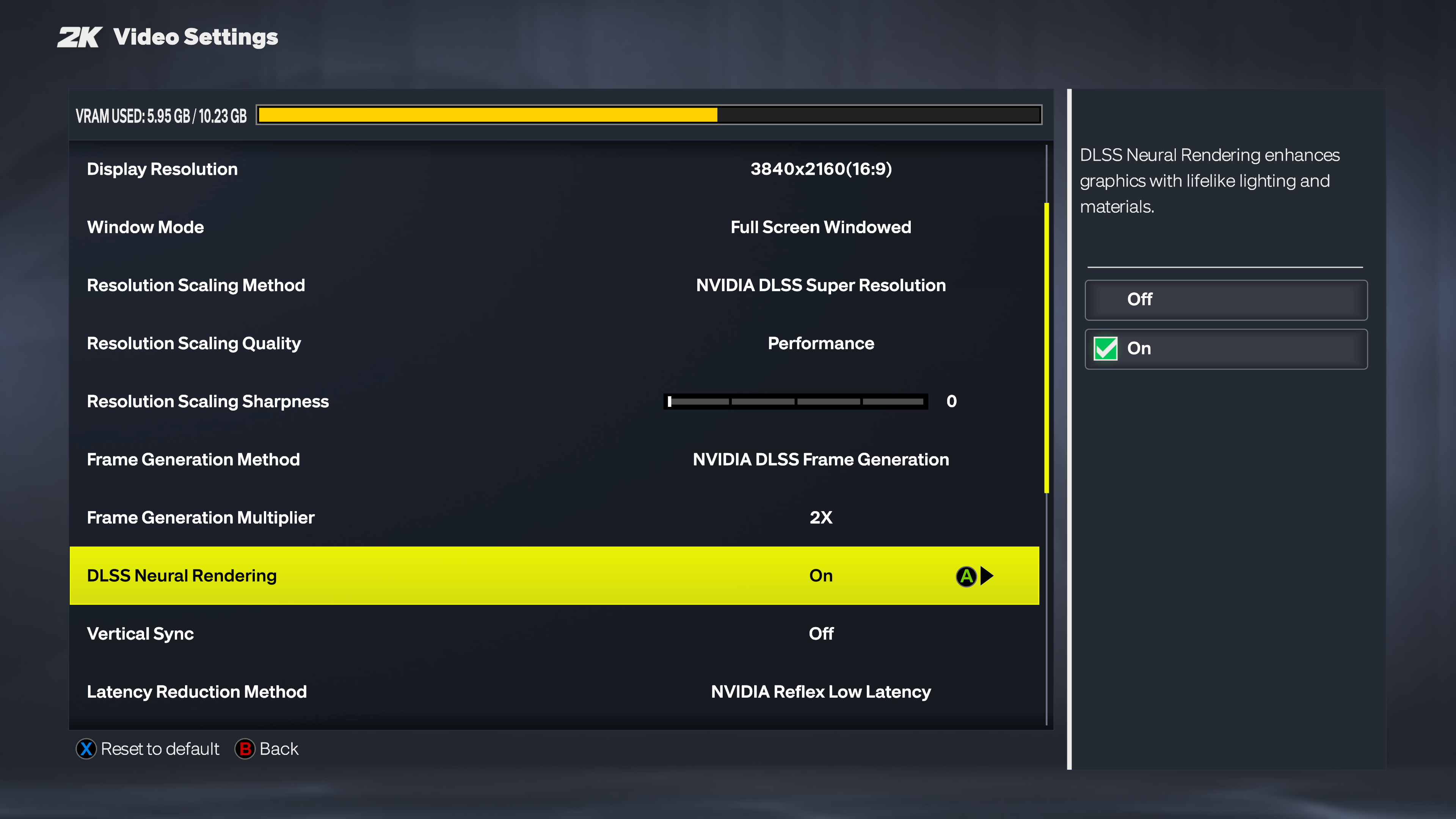
Two things follow. The first is that the promotional menu shot uses a 2X frame-generation multiplier while the performance charts use 6X, so the two pieces of marketing are not describing the same configuration. The second is that a sub-6 GB working set at 4K is modest by 2026 standards, which supports NVIDIA's claim that the model is compact enough to run on a single card. For anyone tracking VRAM as the limiting factor on mid-range RTX 50 boards, that is the number worth watching as more games adopt the feature.
In game, players get a single on-or-off switch, and F9 toggles it live during gameplay and replays, which is the quickest way to judge it without trusting a compressed video.
What the studio side gets
The developer controls are the part of the video least covered elsewhere. Studios can pick between several trained models with different weights and mix them per scene, using one for dense outdoor foliage and another for indoor lighting, or different models for gameplay and cutscenes. Two sliders govern the strength of the effect: Structure Intensity for high-frequency detail such as ambient occlusion, reflections and subsurface scattering, and Tone Intensity for broader lighting and colour response, with zero meaning the rendered frame's colours pass through untouched.
On top of that, semantic masking recognises scene objects automatically so a team can push environmental enhancement while holding characters back, and engine-level masking lets artists isolate specific props such as glassware, water droplets or foliage. Visual Concepts says it used a per-pixel uplift mask on player faces specifically to protect the likenesses scanned from real athletes.
What comes next
NVIDIA first announced DLSS 5 in March 2026, when it needed two RTX 5090s to run. The company now claims a 5x improvement over six months that brought it down to a single GPU across the whole RTX 50 range, including laptops, and says further model updates are due in the autumn. It has not named the next games to adopt it, saying only that more titles will integrate DLSS 5 "in the coming weeks and months", so treat any specific title list circulating now as unconfirmed.
Whether the effect is worth a generation-locked upgrade is a question for side-by-side testing on real hardware rather than for a vendor video. What the 11 minutes do establish is that this is a rendering stage with published controls and published constraints, which is more than most graphics announcements arrive with. The 2K announcement on Steam and the wider DLSS lineage both point the same way: this is being positioned as a permanent pipeline stage, not a one-game showcase.
DLSS 5 introduces 3D-Guided Neural Rendering, which uses AI to infuse game scenes with lifelike lighting and materials. Developers tune the final output for each game to bring their artistic vision to life.
— NVIDIA GeForce (@NVIDIAGeForce) on X
Official links
Lena tests the hardware that games run on, from handheld thermals to controller latency. If a spec sheet is doing something suspicious, she has already opened the device.