How to Win Your First Run in Dicevaders: Dice, Budges and Chrono Explained
Pengonauts' three-person Dicevaders is out now on Steam and Switch 2. Here's how its dice, Budges and Chrono tokens combine into winning combos.

Dicevaders left early access and launched in full on September 29, 2026, built by a three-person Montreal studio called Pengonauts and published by Playstack, the label behind Balatro. It's a dice-based roguelike deckbuilder set in the StarVaders universe, except this time you're commanding the alien invasion instead of fighting it off. New players tend to lose their first few runs for the same reason: they treat every dice roll as a one-off scoring event instead of learning the handful of systems that actually decide whether a run snowballs or stalls out.
What Every Round Actually Comes Down To
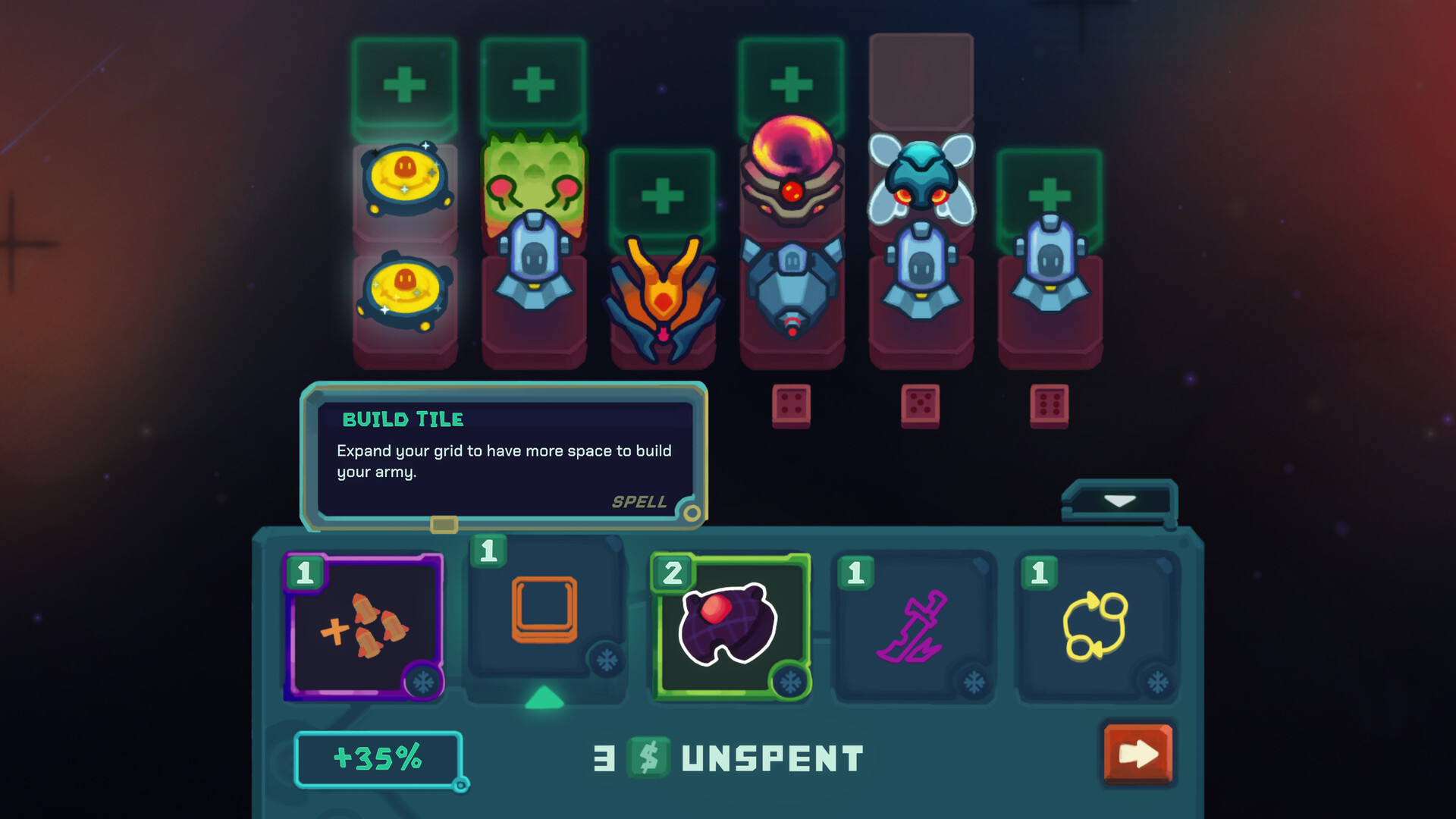
Each encounter in Dicevaders gives you four turns to push your army's Total Attack score past the enemy's Target Defense. Clear it and you advance to the next StarVaders pilot; fall short and you lose health instead of starting over, so a rough round isn't necessarily a wasted one. The board itself is six columns wide, and each column corresponds to a specific die value — dropping a die into its matching column spawns or powers up a unit sitting there. Multiplier slots sit above those columns and are bought between rounds, and they're what turn an ordinary roll into a round-ending combo.
Before worrying about any particular build, get comfortable reading the board itself:
- Check which columns already have a multiplier invested before deciding where to route a die — an average roll into a stacked column usually beats a strong roll into an empty one.
- Track your remaining turns against the gap between your current Total Attack and the Target Defense; you don't need your biggest turn first, you need your biggest turn whenever the gap is still closeable.
- Resist placing every die the instant it lands. Dicevaders lets you see the whole row before committing, and the best column for a die often only becomes clear once you see what else rolled alongside it.
Budge and Chrono Do Different Jobs — Don't Mix Them Up
Two tools carry almost all of the decision-making weight in Dicevaders, and confusing them wastes resources fast. Chrono rerolls a die outright, replacing its value with a fresh one. Budge nudges a die's existing value up or down by one, which matters specifically because a die's value is what decides which column it activates. In practice, Chrono is for salvaging a dead roll with nothing useful on the row at all, while Budge is for routing an already-decent roll into the exact column your current build needs.
Treat Budge as the scarcer, more precise resource of the two. Spending a Budge to nudge a 4 into a 5 so it lands on a column with a live multiplier is usually worth more than burning a Chrono and hoping for something better, because Budge lets you react to information you already have instead of gambling on information you don't.
Combos Beat Raw Numbers
It's tempting to treat every die as an isolated scoring chance, but Dicevaders rewards matching values across the row — pairing, tripling or quadrupling the same number before you commit triggers escalating effects on top of whatever the column itself provides. That's the real reason to hold a Budge in reserve rather than spending it the moment a column opens up: sometimes the stronger play is nudging a die to match two others already sitting in the row, even when the column it lands in isn't your highest-value one.
Multipliers compound this further, and spreading your early purchases evenly across all six columns is usually the wrong instinct. Decide on two or three target columns in the first couple of rounds, keep feeding those specific multiplier slots, and let the other columns contribute whatever they roll naturally rather than actively building toward them.

Your Commander Choice Changes the Whole Plan
Commanders reshape the math of a run rather than just its flavor. Pengonauts' own demo build showcased an alternate commander nicknamed Blob Girl, who trades some early safety for tools that cost health to deploy and mini dice that auto-roll once your main dice are locked in — a sharper, riskier playstyle than the standard commander's. The full release expands that roster further, and each commander carries its own synergies and experience scaling, so a strategy built around stacking one huge column can be the right call on one commander and actively wrong on another.
For a first clear, it's worth picking whichever commander rewards patience over burst damage. Total Attack accumulates across all four turns rather than resetting, so a commander that lets you build steadily toward the Target Defense number is more forgiving to learn on than one designed around spiking a single enormous turn you haven't yet learned how to set up reliably.
The Legendary Pilots Break Your Routine on Purpose
Dicevaders' challenge fights pit you against legendary Pilots pulled directly from StarVaders, and each one disrupts your usual rhythm in its own specific way rather than simply hitting harder than a standard round. Go into these fights expecting the basics to change — a Pilot might restrict which columns are usable on a given turn or interfere with how your rerolls behave — and head in with at least one Chrono or Budge banked rather than arriving empty-handed after spending down against ordinary enemies beforehand.
The most common way new runs fall apart isn't a bad roll; it's reacting to a bad roll by abandoning the two or three columns already invested in. Dicevaders is forgiving about a single weak turn as long as the following turns still feed the same multiplier stacks — switching targets mid-run to chase whatever die happens to look biggest in the moment is what actually turns a recoverable round into a lost one. Stay committed to the plan you made in the first two rounds unless a Pilot's restriction forces your hand.
Where Dicevaders Sits Right Now
Dicevaders is out now on Steam, Nintendo Switch and Switch 2, and Mac for $14.99, and it's currently running a 10% introductory discount through October 13. It sits comfortably next to the deckbuilders that built Playstack's reputation; the publisher's catalogue already includes Balatro, and a bundle pairing Dicevaders with Pengonauts' first game, StarVaders, is listed on Steam for anyone who wants the full universe in one purchase. If StarVaders' deckbuilding scratched an itch, Dicevaders' dice-row twist is worth starting on the default commander and normal difficulty before touching the Pilot challenges — the fundamentals above carry over to every harder fight the game throws at you afterward.
Official links
Sam writes about small studios and the games they ship against the odds, and turns the hardest parts of them into guides that get to the point.