Packed Lair Turns Tetris-Style Building Placement Into Villain Warfare on Steam
Solo Belgian developer Patrick Pilmeyer's Fables of Wits launches Packed Lair today, a roguelike where packing buildings into a cramped lair is the real fight.

Packed Lair is out now. The debut game from Belgian solo developer Patrick Pilmeyer, working under the studio name Fables of Wits, launched on Steam on September 22 through publisher Mystic Forge, asking players to defend an "evil lair" from an endless procession of sword-swinging heroes by treating floor space like the scarcest resource in the game.
A Tiny Lair, an Endless Line of Heroes
The premise is a familiar villain-sim joke played completely straight: you are the evil lord, and the heroes barging into your home are the actual problem. Packed Lair casts that setup as a roguelike run structure. Each attempt starts with a small underground plot and a hand of building tiles to draft, and every run ends when either your monster army holds the line or the heroes finally break through.
What separates it from other lair-defense games is how literally it treats "cramped." According to Fables of Wits, the entire design pivots on the idea that a lair is never big enough for everything you want to build, so choosing what to leave out matters as much as what you place.
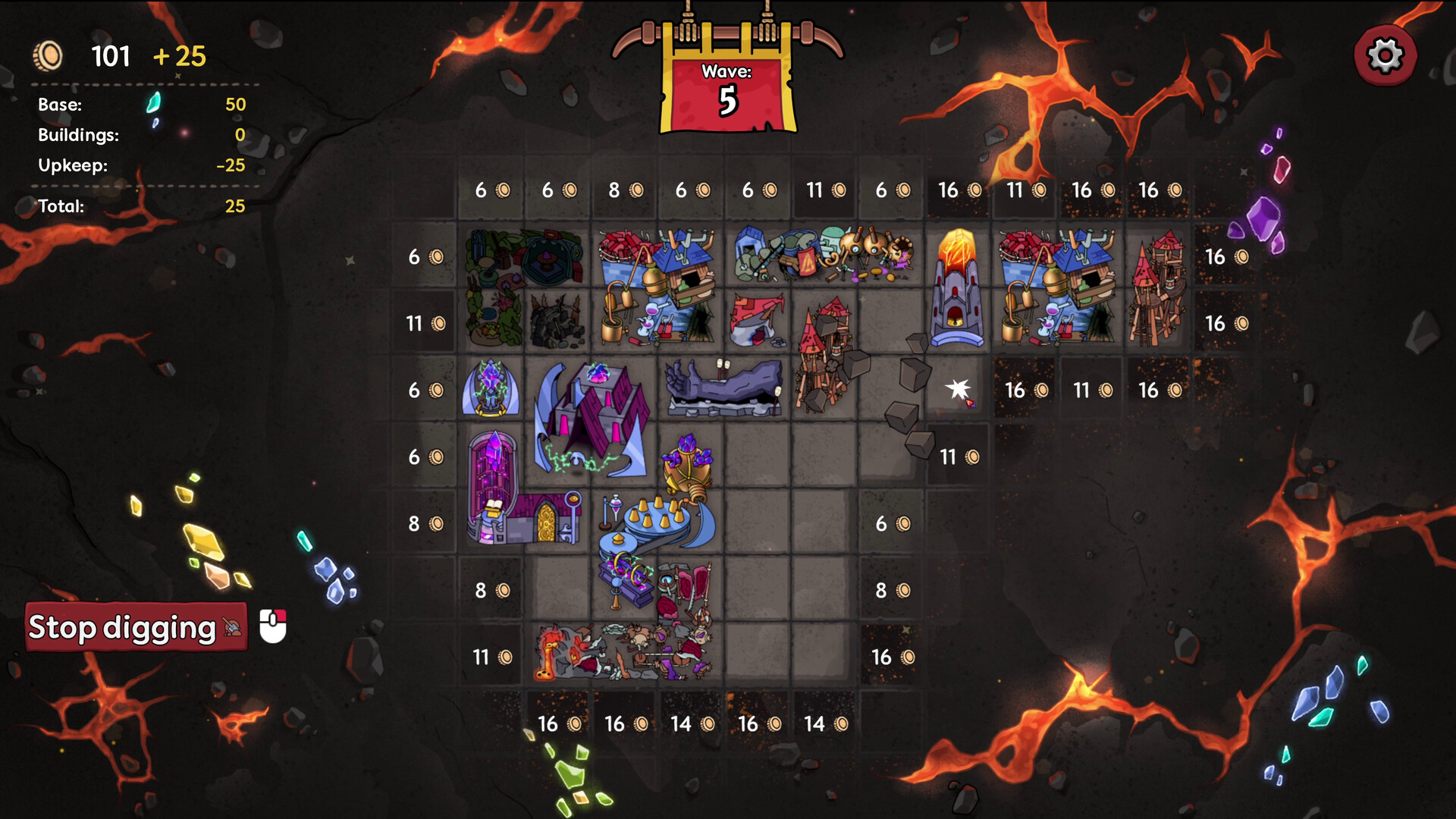
Packing the Lair: Where the Real Strategy Lives
Between waves, players draft buildings and rotate them to fit irregular shapes into the lair's limited grid, similar to a spatial puzzle game. Each structure serves a purpose: some produce minions, some generate gold, others buff the army or unlock new building types for future runs. The trick, per the game's own Mystic Forge listing, is discovering which buildings create synergies when placed adjacent to one another, turning a disorganized cave into what the developer calls "a perfectly packed engine of villainy."
That adjacency system is the game's central hook. A building that looks unremarkable alone can become a run-defining engine once it is wedged next to the right neighbor, and because tile shapes and rotations are limited, players are constantly trading efficiency for square footage. Losing a run to a lair that is simply too full of good ideas is, by design, part of the joke.
Automated Fights, Manual Chaos
Combat itself is an auto-battler. Once a wave begins, goblins, a shaman lizardman, dragons and the rest of the player's roster charge at invading heroes on their own, with the outcome shaped almost entirely by pre-battle preparation. Players aren't purely spectators, though: the game lets them cast spells mid-fight to disrupt enemy formations or swing a losing fight back in their favor, giving each battle a light layer of live decision-making on top of the automated resolution.
Runs escalate from there. New buildings, new monster types and new spell options unlock as players clear waves, and the game offers Easy and Hard difficulty options along with a full progression reset for anyone who wants to start the unlock chain over. A free demo, updated ahead of launch with additional building variety, remains available on Steam for anyone who wants to test the loop before buying.
One Developer, a Decade of Software Experience
Fables of Wits is a one-person operation. Pilmeyer spent more than ten years in the software industry before turning to full-time game development, and Packed Lair is the studio's first commercial release after an earlier prototype, Primal Chronicles, was posted to itch.io. Publisher Mystic Forge, a boutique label focused on strategy, RPG and simulation titles with an unusual hook, picked up the project to handle its Steam launch.
That scale shows up in the scope of the release: Packed Lair is a single-player, Windows-only game with no multiplayer component, built around short, replayable sessions rather than a sprawling campaign. It supports achievements and Steam Cloud saves, and it ships translated into English, French, German, Simplified and Traditional Chinese, Japanese, Russian and Brazilian Portuguese.

Price, Platforms and What Comes Next
Packed Lair is priced at $7.99 on Steam, discounted 10% to $7.19 for a two-week launch window. It is PC-only for now, with no announced console or Mac and Linux ports; Fables of Wits and Mystic Forge have not said whether that will change. Anyone curious can still grab the free demo first, since it carries the same building set as the September 22 update.
For a solo-developed strategy game, the combination of a sharply scoped hook, an actively updated demo and a publisher handling the Steam storefront work is a fairly standard playbook for breaking through the platform's crowded release calendar. Whether Packed Lair's building-adjacency puzzle has enough depth to sustain repeat runs is now something players can judge for themselves.
Official links
Sam writes about small studios and the games they ship against the odds, and turns the hardest parts of them into guides that get to the point.